The Myth of the One True Version of a Traditional Dish
The one true version of a traditional dish is rarely a household fact. Learn to discuss recipe differences with curiosity, context and respect.
The most common mistake in a debate about a traditional dish is treating one remembered recipe as the official original. That claim can cost the conversation its best ingredient: the chance to learn why another household cooks differently. The one true version of a traditional dish is usually a tidy story laid over a messy, living practice.
How does one recipe become “the real one”?
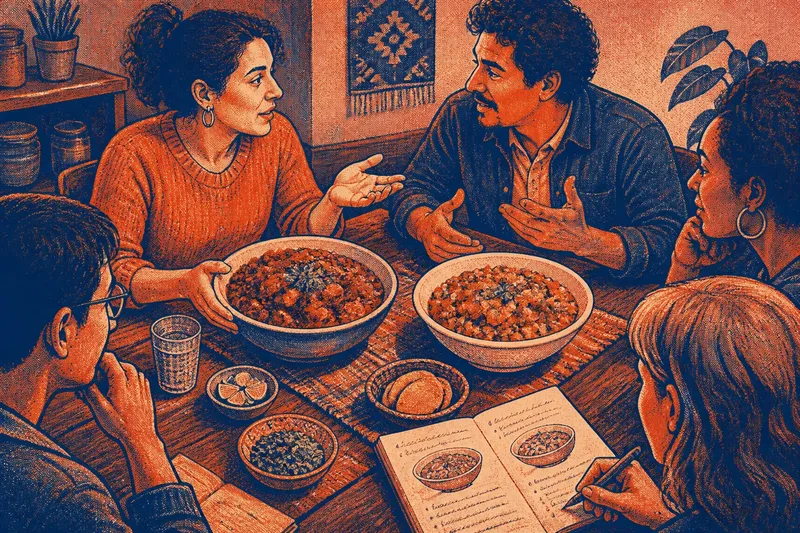
Say a neighborhood food club plans to share a dish that several members grew up eating. Mara brings a version her grandmother made: a soft, slow-cooked preparation with a particular balance of sourness and spice. Luis recognizes the dish, but says his family’s version is firmer, brighter, and finished with an ingredient Mara never uses. Someone at the table asks which recipe is authentic.
The question sounds simple, but “authentic” may mean several things at once: made in a particular region, learned from a relative, cooked for a holiday, or prepared with ingredients available in a certain place. Those meanings can overlap without being identical. A recipe can be authentic to a family’s routine without representing every family in a region.
That distinction matters because recipes often travel through kitchens by memory and habit. A cook may learn by watching, then adjust for a different stove, a new market, or the tastes of the people eating. The dish’s name can stay steady while its texture, seasoning, and serving customs shift.
What changes when the club compares the dishes?
At the club’s next meeting, Mara and Luis agree to describe their versions before judging them. Mara says her grandmother preferred a longer simmer because she liked the ingredients to soften together. Luis explains that his family valued a fresher finish and often served the dish with a particular accompaniment. Neither presents a family preference as a rule everyone must follow.
They also ask where each memory belongs. Was the dish everyday food or reserved for a gathering? Did the cook have access to the same ingredients? Was the recipe learned from a parent, an aunt, a neighbor, or a written card? These questions do not establish a single winner; they make the differences legible.
When the club serves both versions, members can notice what each choice does. The longer-cooked one feels cohesive; the brighter one keeps more contrast between its components. These are observations about the bowls in front of them, not verdicts about a culture. The table gains two useful descriptions instead of one unsupported ranking.
How can you talk about variation without ranking it?
Start with the person and the context, not a claim about what “everyone” does. “How did your family make it?” invites a story. “That isn’t the real version” closes one down, especially when a dish carries memories of migration, scarcity, celebration, or care.
It also helps to name the scale of a claim. “In my household, we use this garnish” is precise and generous. “People from that region always use it” is much broader, and may flatten differences between towns, generations, or families. When you are unsure, ask whether a cook means a personal practice, a local convention, or a widely recognized style.
- Ask what the cook calls the dish and how they learned to make it.
- Describe the difference you notice without calling it wrong or lesser.
- Ask whether a variation is tied to a season, occasion, place, or family preference.
- Use phrases such as “one version” and “in this household” when speaking about a single recipe.
- Credit the person who shared a recipe, especially when you adapt or pass it along.
Not every detail needs a debate. It is rarely worth the effort to turn a garnish, a spelling, or one family’s preferred texture into a test of cultural belonging. Focus instead on what the cook says the choice means and what it contributes to the meal.
What questions help when a dish has many versions?
Can a dish be authentic if the ingredients change?
It can be authentic to a household or circumstance even when an ingredient has been substituted. The useful question is what prompted the change and whether the cook still recognizes the dish as theirs.
Does a family recipe represent an entire region?
Usually, one family recipe can tell you about that family’s practice, not every kitchen in a region. Treat it as a meaningful account rather than a complete map.
How should I describe a version I have never eaten before?
Describe what you can observe: its aroma, texture, serving style, or balance of flavors. Then ask the cook how those qualities fit their own tradition, rather than guessing at a history.
Is it disrespectful to adapt a traditional recipe?
Adaptation is not automatically disrespectful; context and credit matter. Be candid about what you changed, avoid presenting your adaptation as the sole original, and listen if someone explains why a particular practice matters to them.
What does the club take away from the meal?
After tasting both bowls, the club writes two descriptions for its shared recipe folder rather than choosing a winner. Mara’s entry notes her family’s slow-cooked texture and the memory attached to it; Luis’s records the brighter finish and the accompaniment his family favors. The folder gives readers a place to begin, not a border around what counts.
That is a more useful way to handle the one true version of a traditional dish: ask whose version is being described, what shaped it, and how the cook wants it named. A recipe can have roots without having a single, final form. When the conversation leaves room for that, a shared meal becomes a meeting of histories rather than an audition for authenticity.